Micro/nanoscale phase-change physics
Intelligent thermal management for chiplet AI semiconductors and data centers
Intelligent thermal management for next-generation mobility and
defense technologies
Nanoengineered thermal materials for enhanced heat transfer
Nanoengineered thermal materials for controlling energy transfer
Intelligent phase-change vision
Liquid–vapor phase change involves multiscale and transient droplet dynamics that are difficult to quantify using conventional analysis methods. Our research develops intelligent vision-based frameworks for analyzing phase-change phenomena, particularly droplet condensation, by combining high-resolution imaging, deep learning-based segmentation, droplet tracking, and large-scale data mining. Through this approach, dynamic processes such as nucleation, growth, coalescence, sweeping, and re-nucleation can be quantitatively characterized from micro-scale to macro-scale observations. The extracted visual features, including droplet size distribution, population density, coalescence statistics, growth behavior, and condensation mass, are integrated with physical analysis and machine learning models to predict condensation performance under various surface and environmental conditions. This research aims to bridge experimental visualization, mechanistic understanding, and data-driven prediction, ultimately providing design guidelines for advanced surfaces and phase-change systems in thermal management, desalination, water harvesting, and energy applications.
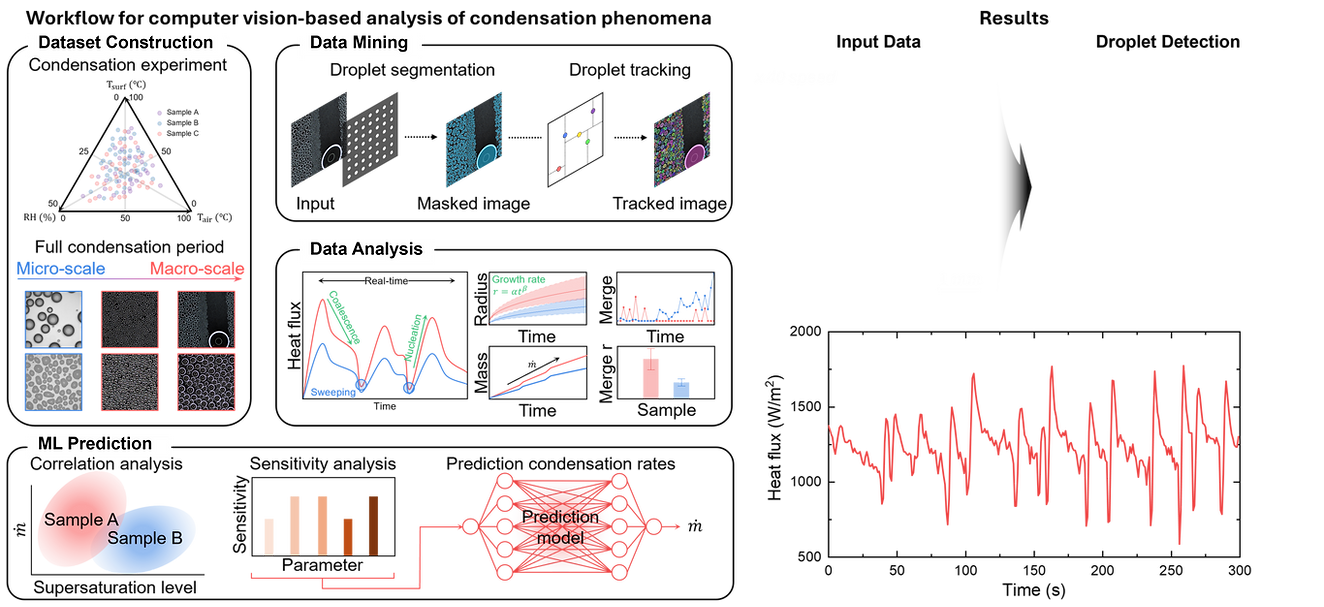
[1] D. Lee, S. Roh, J. Jeong, K. Yoon, J. Lee, Y. Nam, Analysis of Multiscale Condensation Phenomena Using a Zero-Shot Computer Vision Framework. Advanced Science 2026;13(10):e21372. Link.