Micro/nanoscale phase-change physics
Intelligent thermal management for chiplet AI semiconductors and data centers
Intelligent thermal management for next-generation mobility and
defense technologies
Nanoengineered thermal materials for enhanced heat transfer
Nanoengineered thermal materials for controlling energy transfer
Two-phase closed thermosyphon
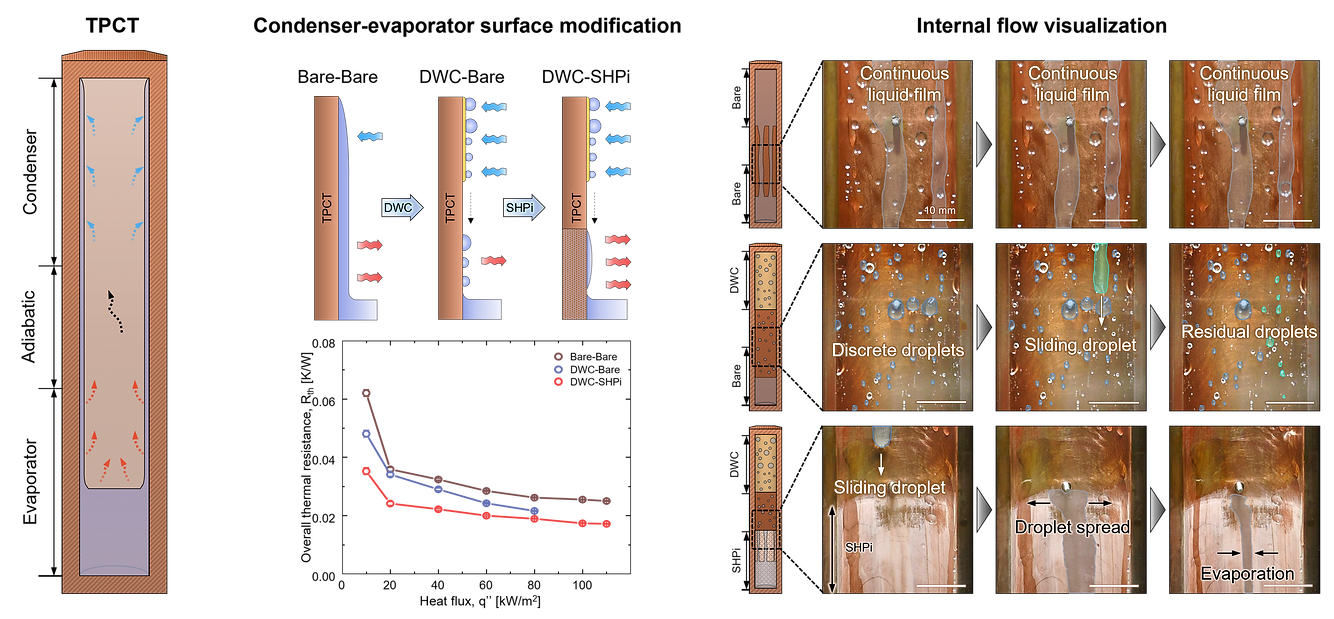
Growing energy demand and environmental concerns have attracted attention to the need for efficient thermal management technology. Among various systems, a two-phase closed thermosyphon (TPCT), also known as a wickless heat pipe, has emerged as a promising solution due to its tunability, passive operation, and cost-effectiveness in heat transfer applications. Since the thermal performance of a TPCT is determined by the coupled behavior of evaporation, vapor transport, condensation, and condensate return, surface modification of both the evaporator and condenser sections has been widely investigated to reduce thermal resistance and enhance heat transfer. In the evaporator section, micro/nanostructured surfaces, porous coatings, grooves, and wettability-controlled layers can increase the effective heat transfer area, provide additional nucleation sites, and promote liquid spreading. Meanwhile, in the condenser section, hydrophobic or superhydrophobic surfaces can promote dropwise condensation, accelerate condensate removal, and reduce the thermal resistance associated with liquid film formation. However, the improvement of one section does not necessarily lead to proportional enhancement of the overall TPCT performance, because the evaporator and condenser are strongly interdependent within a closed two-phase system. Therefore, beyond individual surface modification, it is essential to understand the complex internal interactions between evaporation, condensation, and liquid return inside the TPCT. Our group investigates internal surface modification of TPCTs combined with flow visualization, aiming to directly understand how modified evaporator and condenser surfaces influence vapor–liquid behavior, condensate return, and overall thermal performance. This approach allows us to identify internal transport mechanisms and performance-limiting factors that are difficult to capture through thermal measurements alone, providing insights for the optimal design of surface-modified TPCTs.